An exotic paddling canoe from the remote Pacific Islands of Yap has arrived at Point of Pines, a 17th century plantation on Edisto Island, South Carolina. The native mahogany outrigger will be the first of its kind to enter South Carolina’s coastal waters in over 400 years of recorded nautical history.
A symbol of the longstanding friendship between the United States and the Federated States of Micronesia (FSM), the canoe represents months of painstaking craftsmanship, and centuries of traditional technique. This custom craft was hand built by the master carvers and apprentices with “Waa'gey,” a cultural preservation and mentorship program operating throughout Yap.
The westernmost state in Micronesia, the tiny islands and atolls of Yap are scattered across 500 miles of ocean, just south of the US Territory of Guam. An American protectorate following its liberation in World War Two, Micronesia is now a sovereign nation in a special “Compact” with the US.
Gift of this one-of-a-kind craft was prompted by generous support from private citizens across the United States –and in particular South Carolina– following Super Typhoon Maysak, a record-setting storm that ravaged Yap and Chuuk States in the spring of 2015. Delivery of the donated canoe is being organized by Habele, a South Carolina headquartered charity serving students throughout Yap and across Micronesia. Habele solicited, coordinated and delivered relief supplies to pupils and educators in the wake of the storm.
Showing posts with label Outer Islands. Show all posts
11.09.2015
6.05.2015
Outer Island Students Prepare to Graduate!
Today was an exciting day for the 32 Outer Island seniors who determined to finish their final year of high school, despite having been displaced by the violence of Typhoon Maysak. Every one of the seniors completed their classes today, and are ready to graduate!
After the storm destroyed their local high schools, these students were transferred to Yap, where they finished out the school year at the Yap High School campus. Fortunately, the dedicated Peace Corps teachers - Caroline, Tianna, Patrick and John - were able to continue teaching the students who they were formally serving on the Outer Islands. A big thanks to these hardworking teachers who have put so much into the students!
5.13.2015
Traditional, Sustainable Food after Maysak Destruction
Micronesia's remote Outer Islands were fortunate enough to receive emergency supplies of food and water immediately after the destruction of Typhoon Maysak. These rations are crucial for short term survival, but the need to revive traditional, sustainable food sources is an ongoing need.
Volunteers with Waa'gey - a Habele partner organization - have jumped in to help bolster relief work with a long-term food solution for some of Yap State's most isolated Outer Islands.
Drawing on traditional and local knowledge of storm relief, Waa'gey volunteers collected over fifty baskets of traditional crop seedlings, which they will personally deliver to the atolls of Faraulep and Piik. Inside the baskets are over 500 plants, including taro, banana, tapioca, sweet potatoes and even mahogany trees. These are familiar crops, identified by islanders as the most targeted means of helping remote communities regain self-sufficiency.
5.01.2015
Islands 101: The Basics
![]() |
| Lagoon in Ulithi Atoll. |
Habele donors and volunteers often ask questions about the daily lives of the people who live thousands of miles away in beautiful Micronesia. Go here to read, "Where is Micronesia?"
The Outer Islands of Yap provide a fascinating look into traditional island culture and lifestyle. Even today, many remote islands and atolls live in much the same way as they have for millenia.
Villages
Outer Islanders live in small villages facing the calm waters of the atoll’s lagoon. The lagoon provides a shallow, safe location for washing, swimming, gathering fish and shellfish, and launching canoes. This is an extremely valuable feature, considering that these tiny strips of land are surrounded by millions of square miles of some of the deepest water on Earth!
4.29.2015
Islands 101: Where is Micronesia?
![]() |
| The beautiful atoll of Ulithi (Yap State) is a picturesque example of one of Micronesia's many Outer Islands |
Since Typhoon Maysak ravaged Micronesia, many Habele donors and volunteers to the “Moving Past Maysak” effort have been asking basic questions about this remote and beautiful region.
Where is Micronesia?
“Micronesia” is an umbrella term for a region in the Western Pacific Ocean. This massive section of the Pacific is over 3 million square miles, with thousands of islands scattered throughout. These islands are grouped together in six different sovereign countries. One of these island nations is the “Federated States of Micronesia,” also referenced as the “FSM.” The term “Micronesia” is most commonly used to refer to the 600 islands and atolls making up the FSM.
These islands are themselves grouped into four states: Kosrae, Pohnpei, Chuuk, and Yap. Kosrae is the state furthest to the east (toward Hawaii), with Yap being the westernmost state (closest to the Philipines). Each of these states have distinct cultures, languages, and natural resources.
4.23.2015
Moving Past Maysak: Dinner and a Movie
The recovery process from Super Typhoon Maysak
will be long and arduous, but residents of Micronesia's Outer Islands
are standing strong. Your support has a direct impact on the lives of
many islanders who have lost everything!
Earlier this
month, the record-breaking storm tore through the isolated Outer
Islands, leaving behind the wreckage of homes, community buildings,
churches, and schools. Survivors are bravely working to "Move Past
Maysak," but many remain without critical supplies. You can read more
about the needs of determined Outer Island students here.
Thanks
to the generosity of Habele donors and volunteers, some relief boxes
have already been making their way to the islands. Can a small box of
first aid supplies have an impact on a such a massive scene of
devastation? The overwhelming response from our volunteers on the ground
is, "Yes!"
For the cost of going out to dinner and a movie
with your significant other, you can bring practical, targeted relief
to typhoon survivors on Micronesia's Outer Islands.
4.21.2015
Moving Past Maysak: Outer Island Students Arrive on Yap

Students from storm-wrecked Ulithi have arrived on Yap. Please consider giving to provide them with necessary toiletries and school supplies.
Outer Island students are facing unique challenges in the wake of Super Typhoon Maysak.
Every year, hundreds of children from dozens of isolated islands travel across the open ocean – some students traversing hundreds of miles – to attend Outer Island High School in the isolated atoll of Ulithi.
Everything changed when Super Typhoon Maysak obliterated historic Outer Island High School. Students (OIHS) from storm-ravaged islands were suddenly left without even basic educational facilities, or supplies to finish the school year.
Local stakeholders and community leaders quickly put into place an alternate plan. With no local option for schooling, thirty-two seniors from devastated Outer Islands matriculated to the state capitol of Yap to complete their studies and graduate.
Many of these students have had their own homes destroyed, and are now now attending an unfamiliar school, far from their families, on an island with a different language and customs. To make the situation even more pitiable, many of these students have arrived without even basic personal belongings or school supplies.
4.15.2015
Moving Past Maysak: McREL Direct Links
Habele is working with McREL International to organize a direct bridge of donations from US students to Island students recovering from the storm.
Early in April, a massive super typhoon ravaged Micronesia, a chain of remote islands scattered across the Western Pacific, about 500 miles east of the Phillipines.
Home to a primarily subsistence economy, Micronesia's most remote "Outer Islands" lay directly in the past of this category 5 typhoon with winds up to 155 mph. The islands have deep historic and strategic ties to the US.
Habele has been sending Response Kits and Recovery Kits to families and local community organizations. You can help this all-volunteer effort by donating right now. We've highlighted other reputable groups and individuals serving victims as well.
Habele is also partnering with our friends at McREL International to establish Direct Links between the students and educators impacted by the storm and students and educators in Colorado and Hawaii who want to help.
This coordinated in-kind donation program is based on islander articulated needs for students whose schools have been leveled or catastrophically damaged. A call to action shared with certain public schools in Colorado explains:
4.14.2015
Moving Past Maysak: Action Grants!
Early in April, a massive super typhoon ravaged Micronesia, a chain of remote islands strewn across the Western Pacific.
Home to a primarily subsistence economy, Micronesia's most remote "Outer Islands" lay directly in Super Typhoon Maysak's violent path. The islands have deep historic and strategic ties to the US.
Habele has been sending Response Kits and Recovery Kits to families and local community organizations. You can help this all-volunteer effort by donating right now. We've highlighted other reputable groups and individuals serving victims as well.
Habele is also sending micro Action Grants directly to local partners who've demonstrated exceptionally innovative or sustainable responses.
Home to a primarily subsistence economy, Micronesia's most remote "Outer Islands" lay directly in Super Typhoon Maysak's violent path. The islands have deep historic and strategic ties to the US.
Habele has been sending Response Kits and Recovery Kits to families and local community organizations. You can help this all-volunteer effort by donating right now. We've highlighted other reputable groups and individuals serving victims as well.
Habele is also sending micro Action Grants directly to local partners who've demonstrated exceptionally innovative or sustainable responses.
4.11.2015
Typhoon Maysak: How can I help Micronesia recover?
Early in April, a massive typhoon ravaged Micronesia, a chain of remote islands strewn across the Western Pacific.
Particularly hard hit were the Atolls of Ulithi (Mogmog, Falalop, Asor and Federai Islands), Fechaulap, and the Island of Fais.
You can help the recovery from this devastating storm. Habele is proud to recommend (this growing list):
SUPPLY CHAIN
Pacific Missionary Airlines (PMA): Decades of service and experience translates into an immediate response, daily delivering subsistence materials to islands with runways, notably Ulithi and Fais. Updates on the PMA Facebook page. Give to PMA here.
4.05.2015
Typhoon Response Kits: Moving Past Maysak
Habele donors and volunteers are answering the call of those who've endured Super Typhoon Maysak! That record breaking storm devastated low lying islands and atolls of Yap State, Micronesia. You can help!
Habele volunteers have begun assembling simple kits based on the specific requests of on-island partners at schools and community organizations. Each contains: 20 bars of antibacterial soap; 3 tubes of antibacterial ointment; 4 canisters of mosquito repellent; 2 bottles of anti diarrhea medicine; 3 small bottles of anti diarrhea pills; 2 bottles of ibuprofen pills, 1 bottle of acetaminophen; 2 bottles of children's pain reliever; 2 bottles of children' chewable vitamins.
Habele -an all volunteer charity- is able to purchase the supplies for $131 per kit and send them for a further $16 in postage directly to communities on Ulithi (Mogmog, Falalaop, Federai and Asor), Fais, and Fechaulap.
Special thanks to James McDonald and Daniel Nodine, both of Columbia, SC; Leslie Hittner of Winona, MN; and Cynthia Rookus of Jamestown, TN for their immediate and generous PayPal donations to Habele!
Please donate now: or send check or money order to
Habele, 701 Gervais St, STE 150-244, Columbia, SC 29201.
Habele is a tax exempt, all-volunteer, US based nonprofit with a proud history of high impact support for our partners in Micronesia.
2.10.2012
Traditional Canoes in the Caroline Islands
Habele directors and volunteers have
been working to support young men from the Atoll of Lamotrek living on Yap Proper. Yap is the state capital of one of four states in the Federated States of Micronesia (FSM). A
club was organized in November of 2011, with weekly meetings in Gargey. The
group has set itself very ambitious goals.
Working with elders from the Outer
Island community on Yap, club members have put coconuts husks to sea, which
will be ready for local twine rope making by early 2012. They also started
carving a mid size traditional dugout canoe, building towards the goal of
initiating the creation a second, much larger canoe by mid 2012. Habele donors
will help bear the costs of sending traditional building materials and tools
from Lamotrek to Yap and back on the state owned cargo ship to facilitate the process.
10.14.2011
What is Micronesia?
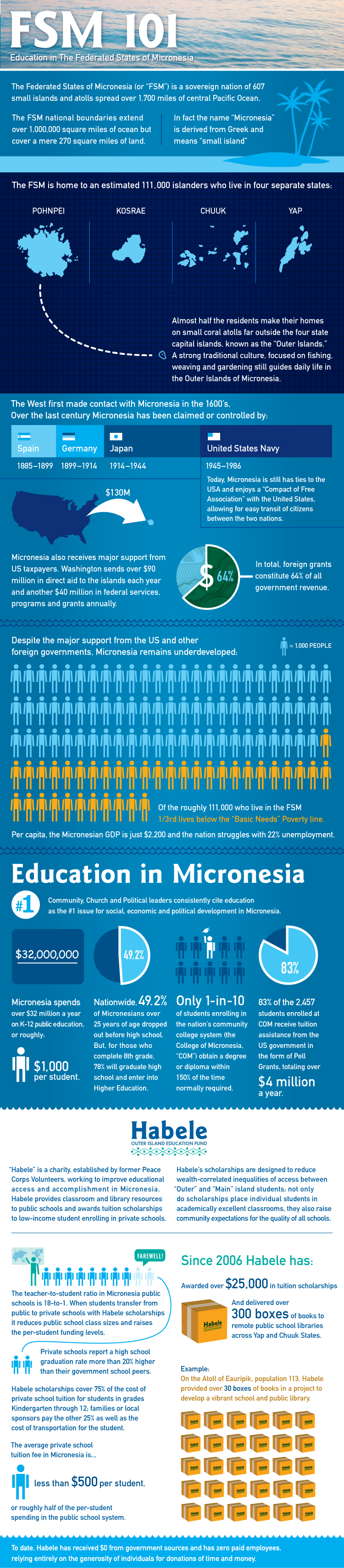
What is Micronesia? Where is Micronesia? And how can I help students there?
Learn all this and more by viewing the latest edition of the Habele Micronesia infographic: "FSM 101."
Share
12.06.2010
7.25.2010
Mau Piailug, Master Navigator from Satawal
The Washington Post has published an obituary for Mau Piailug, the master Navigator from the island of Satawal.
In 1976, Mr. Piailug made international headlines when -- using nothing but nature's clues and the lessons he'd learned from his grandfather, a master navigator schooled in traditional Micronesian wayfaring -- he steered a traditional sailing canoe more than 3,000 miles from Hawaii to Tahiti.
The journey was a project of the Honolulu-based Polynesian Voyaging Society, co-founded by anthropologists interested in the enduring mystery of how the Pacific's scattered islands, often separated by hundreds of miles of water, had become populated by peoples who lacked nautical technologies such as the compass and sextant.
Many scientists had believed that Polynesians, unable to navigate across vast seas, had arrived on various islands by accident when their boats had floated off course. Mr. Piailug's feat showed insteadthat indigenous peoples could indeed have deliberately explored and colonized Pacific islands.
9.17.2009
Traveler Magazine ranks Micronesian Outer Islands a "Paradise Found"
The remote Outer Islands of Yap, located in the Federated States of Micronesia, have been featured in the October 2009 issue of National Geographic Traveler magazine.
The article, focusing on the Ulithi Atoll, is titled "Way Out and Warmhearted." It characterizes the four inhabited Ulithian islands (Falalop, Asor, Mogmog, and Federai) as "strong[ly] traditional," and home to "clear waters rife with life."
Traveler's profile of the the Outer Islands of Yap is part of that magazine's 25 anniversary feature "50 Places of a Lifetime."
Neil Mellen, the author, explains:
Life on this paradise has its inequities and struggles, but people are warmhearted and friendly, and they willingly share their natural bounty. Sitting communally as the sun set, passing a cup of tuba and contributing my own stories, I realized that around this drinking circle the kindness of the Outer Island people shines the brightest.Mellen, a former Peace Corps Volunteer who served on Falalop and Asor, Ulithi, is a Director of the Habele Outer Island Education Fund, a charity serving students in Micronesia.
1.17.2009
Habele Board Members visit Yap State

Two of Habele's directors just returned from a three week trip to Yap and the Yap State Outer Islands to promote awareness of the Habele scholarship and book donation programs.
Photos of the trip can be found here.
In addition to meeting with Habele scholarship recipients, the Directors visited with independent school headmasters, public education officials and local community members. Directors also provided an interview to radio hosts at the local station serving Yap State.
"It was great to renew, expand, and intiate new relationships on Yap and in the Outer Islands," said Marc McNamara of the Habele Outer Island Education Fund. "Based on our meetings and planning sessions with public and independent educators we hope to again expand the scope of our efforts in the next school year."
Habele donors will be pleased to hear that all costs associated with the trip, including airfare and lodging, were paid for by the Directors themselves in the form of in-kind donations.
Learn more about the role of Habele in expanding educational access and accomplishment in the Outer Islands of Yap and Chuuk state at www.habele.org.
10.09.2007
Modern History of the Ulithi Atoll, Part IV
This is the third in a series of blog entries chronicling the modern history of the Ulithi Atoll. For background information see Part I (1529 to 1730), Part II (1731 to 1899), and Part III (1900-1943).
The Americans came to Ulithi in September of 1944. Their presence would lead to far greater changes than the previous three occupying powers combined. The U.S. sought to make the lagoon a naval base, to serve as a point of consolidation for its eastward drive towards the Japanese Mainland, and most immediately the attack on Okinawa. The Japanese had left Asor, and the US landing forces encountered no resistance when the Americans landed. In order to make the maximum possible use of the limited land space the islands of the Atoll provided, they consolidated all Ulithians onto Federai. By displacing the other islands’ inhabitants they were able to create an airfield on Falalop, a logistics center on Sokoli, and an area for fleet rest and relaxation on Mogmog.

USS Enterprise CV-6 crewmen at the beach on the island of Mog Mog, Copyright US Library of Congress
With all the Atoll’s native inhabitants squeezed on the thin island of Federai (a few are said to have remained on nearby Ladoua) there was no hope of any sort of agricultural subsistence. Furthermore the lagoon’s water were said to be dirty from oil (from US and Japanese ships) as well a harboring naval mines. The navy simply brought huge rations of canned goods, rice, sides of meat, and other foods for the Ulithians, who received such an abundance of these, that they were said to have often feed them to their pigs once they had themselves become full. The Navy also sent a handful of medical doctors to deal with an outbreak of Yaws . In accordance with practice in the Pacific, the Navy itself served as the ruler and administrator of the Atoll .
After the War the Navy withdrew, though a contingent of US Coast Guard remained to man the small station that had been created. Although the Navy made some token efforts at cleaning up the islands where people had formerly lived (Falalop, Asor, Mogmog, and Sokoli) were for the most part quite barren, the soil replaced with crushed coral (to support the weight of trucks and machines) and the shores and reefs littered with trash and rusting machinery. The Navy sought to wean the Ulithians of their dependency on imported food over the course of a decade as the local foods began to be grown again in significant numbers. The Americans allowed US Jesuits to come and preach on the Atoll, with Father William Walter arriving in Mogmog in 1949.

An American teacher employed by the TTPI on the Ulithi of Atoll, Photo Copyright US Government
The United Nations allowed the United States to rule the islands of the Pacific in a “Strategic Trust Territory.” The “Strategic” qualification meant that the US reported to Security Council rather than the General Assembly of the UN, and that the US had total control of all political and military concerns. This included a prevention of all non-US foreign nationals from entering the territory. The Navy officially passed control to the US Department of Interior in 1951. Although there were efforts made in the direction of basic infrastructure / medical / educational improvement, the reality was that the TTPI was initially not unlike the League of Nations Mandate that the Japanese had exercised in terms of the foreign power’s perception of primary responsibility towards the locals.
The “Strategic” qualification is key to many critics’ understanding of the intent and interest of the Americans through this period, and even through to the present. David Nevin argued in the late 1970s that “Americans have had a disastrous impact in Micronesia. They have been motivated by their interest in the strategic value of the islands and have been guided by a naïve altruism and an arrogant assumption that has allowed no self-questioning.”
A significant tenant of US rule was the insistence that no foreigners could own land within the trust territory, and this included the American Government itself. On Ulithi the Coast Guard acquired land through long-term leases, and this was the case for some sixty acres , primarily the area to the North of the airstrip on Falalop, known as Hapillpill, or “the government side.” It was this land, already secured as “public” in the form of leases that would host the Atoll-wide high school.
The 1960s saw a revision in American perceptions and attitudes. Although planners in the Pentagon were in no hurry to cede islands that had been “given away” in the 1890s only to be earned back through great loss of American blood in the 1940s, military technologies as well as centralization made certain locales very significant (Kwajallein, Guam, Okinawa) while the vast majority of Pacific Islands were admittedly of little strategic value. The whole was considered much greater than the sum of its parts . The Kennedy Administration brought new thinking, and eager optimism, along with much greater funds for the TTPI. Third country nationals, as well as their economic efforts were allowed in, and the Peace Corps arrived in mass to further basic educational and sanitary programs. The overall budget for the TTPI was vastly expanded as well.
A major factor contributing to the change in policy overseen by the Kennedy administration was a 1961 report by the United Nations which painted a rather grim and blaming portrait of the “considerable dissatisfaction and discontent” among the Islands throughout the TTPI . This was particularly damaging, as the US had recently, and quite publicly, announced it support for the anti-colonial stance taken by Angola against its former masters in Portugal.
The days of the Trust Territory Pacific Islands (TTPI), and particularly from the late1960s through the early 1980s represent the peak of foreign involvement and development on Ulithi. Schools were created on each island at the elementary level, as well as an atoll-wide high school on Falalop. During this period the Ulithians continued to recieve a great deal of aid and assistance from the military. Following a disastrous typhoon in the 1960s companies of US Navy Sea-Bees (Construction Battalion) arrived to fabricate new homes for all the Atoll’s families. Water catchments, men’s houses, and other concrete structures were also created with a combination of US leadership / supervision and Ulithian labor. It was during this period Outer Island High School (OIHS) earned a reputation as “The Best In The Western Pacific” when it was headed by an American Contract teacher / principal named James D. Boykin, and staffed by a small army of Peace Corps Volunteers.
Changes in funding did not address the TTPI mechanisms. The control over the “American Pacific” remained with the Department of the Interior. Frustration was voiced by some at the “supreme illogic of giving (the Department of the) Interior dominion over an immense exterior region more than 6,000 miles from Washington .” The exceptions were few, namely direct Department of Defense control of military facilities at Kwajallein, Eniwetok, and Bikini, as well an unclear amount of CIA control over Saipan, home to the intelligence organization’s Asian training facility.

Elementary School Student, Falalop, Ulithi. Copyright Habele
As the Trust Territory came to an end, the various island groups in the Central Pacific could not come to a unanimous decision as to their desired national status, and each negotiated separately. The Marshalls (1986) and Palau (1984) became republics, and the Northern Marianas a US Commonwealth (1978). The Islands of Pohnpei, Chuuk, Yap, and Kosrae established themselves a loose federal structure, termed the Federated States of Micronesia (FSM), and aligned themselves with the United States in a “Compact of Free Association” that while maintaining formal sovereignty for the FSM, provides for a significant portion of direct US aid, and eligibility of FSM citizens for US domestic assistance programs. The Compact was intended to be a one-time treaty to be concluded after twenty years, and culminating in a state of final financial self-sufficiency for the FSM. Having failed to reach these goals, a second compact of free association was agreed upon in the late 1990s.
###
The Habele Outer Island Education Fund is a US-based non profit organization dedicated to promoting educational opportunities and accomplishments in Micronesia's remote Outer Islands.
The Americans came to Ulithi in September of 1944. Their presence would lead to far greater changes than the previous three occupying powers combined. The U.S. sought to make the lagoon a naval base, to serve as a point of consolidation for its eastward drive towards the Japanese Mainland, and most immediately the attack on Okinawa. The Japanese had left Asor, and the US landing forces encountered no resistance when the Americans landed. In order to make the maximum possible use of the limited land space the islands of the Atoll provided, they consolidated all Ulithians onto Federai. By displacing the other islands’ inhabitants they were able to create an airfield on Falalop, a logistics center on Sokoli, and an area for fleet rest and relaxation on Mogmog.

USS Enterprise CV-6 crewmen at the beach on the island of Mog Mog, Copyright US Library of Congress
With all the Atoll’s native inhabitants squeezed on the thin island of Federai (a few are said to have remained on nearby Ladoua) there was no hope of any sort of agricultural subsistence. Furthermore the lagoon’s water were said to be dirty from oil (from US and Japanese ships) as well a harboring naval mines. The navy simply brought huge rations of canned goods, rice, sides of meat, and other foods for the Ulithians, who received such an abundance of these, that they were said to have often feed them to their pigs once they had themselves become full. The Navy also sent a handful of medical doctors to deal with an outbreak of Yaws . In accordance with practice in the Pacific, the Navy itself served as the ruler and administrator of the Atoll .
After the War the Navy withdrew, though a contingent of US Coast Guard remained to man the small station that had been created. Although the Navy made some token efforts at cleaning up the islands where people had formerly lived (Falalop, Asor, Mogmog, and Sokoli) were for the most part quite barren, the soil replaced with crushed coral (to support the weight of trucks and machines) and the shores and reefs littered with trash and rusting machinery. The Navy sought to wean the Ulithians of their dependency on imported food over the course of a decade as the local foods began to be grown again in significant numbers. The Americans allowed US Jesuits to come and preach on the Atoll, with Father William Walter arriving in Mogmog in 1949.

An American teacher employed by the TTPI on the Ulithi of Atoll, Photo Copyright US Government
The United Nations allowed the United States to rule the islands of the Pacific in a “Strategic Trust Territory.” The “Strategic” qualification meant that the US reported to Security Council rather than the General Assembly of the UN, and that the US had total control of all political and military concerns. This included a prevention of all non-US foreign nationals from entering the territory. The Navy officially passed control to the US Department of Interior in 1951. Although there were efforts made in the direction of basic infrastructure / medical / educational improvement, the reality was that the TTPI was initially not unlike the League of Nations Mandate that the Japanese had exercised in terms of the foreign power’s perception of primary responsibility towards the locals.
The “Strategic” qualification is key to many critics’ understanding of the intent and interest of the Americans through this period, and even through to the present. David Nevin argued in the late 1970s that “Americans have had a disastrous impact in Micronesia. They have been motivated by their interest in the strategic value of the islands and have been guided by a naïve altruism and an arrogant assumption that has allowed no self-questioning.”
A significant tenant of US rule was the insistence that no foreigners could own land within the trust territory, and this included the American Government itself. On Ulithi the Coast Guard acquired land through long-term leases, and this was the case for some sixty acres , primarily the area to the North of the airstrip on Falalop, known as Hapillpill, or “the government side.” It was this land, already secured as “public” in the form of leases that would host the Atoll-wide high school.
The 1960s saw a revision in American perceptions and attitudes. Although planners in the Pentagon were in no hurry to cede islands that had been “given away” in the 1890s only to be earned back through great loss of American blood in the 1940s, military technologies as well as centralization made certain locales very significant (Kwajallein, Guam, Okinawa) while the vast majority of Pacific Islands were admittedly of little strategic value. The whole was considered much greater than the sum of its parts . The Kennedy Administration brought new thinking, and eager optimism, along with much greater funds for the TTPI. Third country nationals, as well as their economic efforts were allowed in, and the Peace Corps arrived in mass to further basic educational and sanitary programs. The overall budget for the TTPI was vastly expanded as well.
A major factor contributing to the change in policy overseen by the Kennedy administration was a 1961 report by the United Nations which painted a rather grim and blaming portrait of the “considerable dissatisfaction and discontent” among the Islands throughout the TTPI . This was particularly damaging, as the US had recently, and quite publicly, announced it support for the anti-colonial stance taken by Angola against its former masters in Portugal.
The days of the Trust Territory Pacific Islands (TTPI), and particularly from the late1960s through the early 1980s represent the peak of foreign involvement and development on Ulithi. Schools were created on each island at the elementary level, as well as an atoll-wide high school on Falalop. During this period the Ulithians continued to recieve a great deal of aid and assistance from the military. Following a disastrous typhoon in the 1960s companies of US Navy Sea-Bees (Construction Battalion) arrived to fabricate new homes for all the Atoll’s families. Water catchments, men’s houses, and other concrete structures were also created with a combination of US leadership / supervision and Ulithian labor. It was during this period Outer Island High School (OIHS) earned a reputation as “The Best In The Western Pacific” when it was headed by an American Contract teacher / principal named James D. Boykin, and staffed by a small army of Peace Corps Volunteers.
Changes in funding did not address the TTPI mechanisms. The control over the “American Pacific” remained with the Department of the Interior. Frustration was voiced by some at the “supreme illogic of giving (the Department of the) Interior dominion over an immense exterior region more than 6,000 miles from Washington .” The exceptions were few, namely direct Department of Defense control of military facilities at Kwajallein, Eniwetok, and Bikini, as well an unclear amount of CIA control over Saipan, home to the intelligence organization’s Asian training facility.
Elementary School Student, Falalop, Ulithi. Copyright Habele
As the Trust Territory came to an end, the various island groups in the Central Pacific could not come to a unanimous decision as to their desired national status, and each negotiated separately. The Marshalls (1986) and Palau (1984) became republics, and the Northern Marianas a US Commonwealth (1978). The Islands of Pohnpei, Chuuk, Yap, and Kosrae established themselves a loose federal structure, termed the Federated States of Micronesia (FSM), and aligned themselves with the United States in a “Compact of Free Association” that while maintaining formal sovereignty for the FSM, provides for a significant portion of direct US aid, and eligibility of FSM citizens for US domestic assistance programs. The Compact was intended to be a one-time treaty to be concluded after twenty years, and culminating in a state of final financial self-sufficiency for the FSM. Having failed to reach these goals, a second compact of free association was agreed upon in the late 1990s.
###
The Habele Outer Island Education Fund is a US-based non profit organization dedicated to promoting educational opportunities and accomplishments in Micronesia's remote Outer Islands.
9.30.2007
Modern History of the Ulithi Atoll, Part III
This is the third in a series of blog entries chronicling the modern history of the Ulithi Atoll. For background information see Part I, which covers 1529 to 1730, and Part II, which covers from 1731 to 1899.
At the conclusion of the Spanish America War the United States sought to strip Spain of any of lingering colonies or possessions that might interfere with America’s manifest destiny to reign as the primary power in the Western Hemisphere. This extended to Philippines, which provided so lucrative to its former owners, but not to the smaller and more scattered Islands of Micronesia. America also seemed eager for Spain to have available the liquid cash assets necessary for war reparations. With the consent of the United States, Germany purchased both the Carolines and the Marianas from Spain in 1899. Guam was the sole exception, being retained by the U.S., and it seems to have served the same purpose of naval and economic port of security and transit that the Spanish employed it as.
A German cruiser in Microneisa, circa 1876 Copyright Kingdom of Yap.org
The Germans, like the Spanish before them, were much more interested in Yap Proper, than the smaller islands around it. While busy redistricting and attempting to commercialize Yap, they sent only a few vessels to the outer islands in order to buy Copra (dried coconut meat). This gave the Ulithians and other outer islanders a small amount of money for the purchase of basic goods. The Germans did decree some laws, such as a restriction of the tapping of coconut sap, but these were mostly ignored. The primary impact of the Germans seems to be their decree that extended canoe voyages between islands cease. This was enforced much more thoroughly than their other legislative efforts. Both the laws restricting intoxication and travel seemed to been intended to make the locals more orderly, or at least easier to rule. Following the Great War, Japan assumed control of the islands, as it had joined the cause of the Allies late in the war with the hope of gaining additional lands to increase its regional power.
THE JAPANESE
At the conclusion of the First World War the Allied Supreme Council created a mandate system that stripped the defeated nations of their colonies, and placed them as “temporary wards of the ‘advanced’ nations until they were able, in the words of what became Article 22 of the Covenant, ‘to stand by themselves under the strenuous conditions of the modern world .’” The un-advanced, were passed from the advanced losers to the advanced winners. The Mandate was termed a class “C” which designated those nations on the “’lowest’ stage of development; for them independence was not seen as an optional at all .”
A Japanese observation tower on Asor, photo copyright PacificWorlds.com taken by Drury C. Lee
The Japanese set up a very small presence on Ulithi during their League of Nations Mandate and later Military occupation of Yap (and Micronesia). The location of this small group of rotating men, never more than a dozen at a time, on Asor served to up-heave the traditional power system on Mogmog in small ways. Although active prostylization did not occur on Ulithi itself the Japanese were pleased to tolerate Catholicism on Ulithi, as it seemed to promote order and subservience in the locals throughout the mandate . The Japanese relocated some Ulithians, mostly young males, in order to attend school in Yap Proper. A handful were later sent to trade schools as far way as Palau or the Marianas. Those who were in Yap at the onset of the War were to remain there until the conclusion of Pacific Theatre hostilities, and were often employed in military construction projects such as runway repair. In the years immediately leading up to the War, there was also relocation of some Ulithian men to work at the phosphate mines on Fais. Others went to Angur in Palau to work as unskilled manual labor in pursuance of the goals of the Greater East Asian Co-prosperity Sphere. Not as much interested with (or concerned by) the fact that Japan was able to create conditions for net exportation of goods such as rice and sugar in the region as a whole most contemporary Ulithians note only that it was a period characterized by strict order and development.
As well as locals, some American observers have painted a very glossy version of events during the period. A reporter for the Saturday Evening Post noted in early 1964 that “by the mid-1930s energetic Japanese had colonized extensively, building sugar mills and pearl centers, mines, fisheries, and a thriving copra trade. The major islands, bustling centers for commerce became progressive modern in their way of life.” Indeed there were a few sites hosting great leaps in development, but on the whole this is a rather simplified take on a mercantilist / colonial system, that was for a time directly controlled through a military apparatus, and included a limited use of coerced labor as the War came to an end and the Japanese were under greater attack .
We might do well to question the degree of direct impact the Japanese had on Ulithi itself. In his Pacific Islands Douglas L. Oliver illustrates a juxtaposition of the larger islands (contemporary state capitals) where “native life was transformed, sometimes beyond recognition” and those “out-islands” including Ulithi Atoll where the foreign influence was less direct and significant . He argues that with “no immediate Japanese need for their lands or persons they were left for the next batch of foreign masters to transform.” These next “masters” were the Americans who brought with them many shifts in life and thought.
Part IV will cover from 1944 through to the 1960s.
The Habele Outer Island Education Fund is a US-based non profit organization dedicated to promoting educational opportunities and accomplishments in Micronesia's remote Outer Islands.
At the conclusion of the Spanish America War the United States sought to strip Spain of any of lingering colonies or possessions that might interfere with America’s manifest destiny to reign as the primary power in the Western Hemisphere. This extended to Philippines, which provided so lucrative to its former owners, but not to the smaller and more scattered Islands of Micronesia. America also seemed eager for Spain to have available the liquid cash assets necessary for war reparations. With the consent of the United States, Germany purchased both the Carolines and the Marianas from Spain in 1899. Guam was the sole exception, being retained by the U.S., and it seems to have served the same purpose of naval and economic port of security and transit that the Spanish employed it as.
A German cruiser in Microneisa, circa 1876 Copyright Kingdom of Yap.orgThe Germans, like the Spanish before them, were much more interested in Yap Proper, than the smaller islands around it. While busy redistricting and attempting to commercialize Yap, they sent only a few vessels to the outer islands in order to buy Copra (dried coconut meat). This gave the Ulithians and other outer islanders a small amount of money for the purchase of basic goods. The Germans did decree some laws, such as a restriction of the tapping of coconut sap, but these were mostly ignored. The primary impact of the Germans seems to be their decree that extended canoe voyages between islands cease. This was enforced much more thoroughly than their other legislative efforts. Both the laws restricting intoxication and travel seemed to been intended to make the locals more orderly, or at least easier to rule. Following the Great War, Japan assumed control of the islands, as it had joined the cause of the Allies late in the war with the hope of gaining additional lands to increase its regional power.
THE JAPANESE
At the conclusion of the First World War the Allied Supreme Council created a mandate system that stripped the defeated nations of their colonies, and placed them as “temporary wards of the ‘advanced’ nations until they were able, in the words of what became Article 22 of the Covenant, ‘to stand by themselves under the strenuous conditions of the modern world .’” The un-advanced, were passed from the advanced losers to the advanced winners. The Mandate was termed a class “C” which designated those nations on the “’lowest’ stage of development; for them independence was not seen as an optional at all .”
A Japanese observation tower on Asor, photo copyright PacificWorlds.com taken by Drury C. LeeThe Japanese set up a very small presence on Ulithi during their League of Nations Mandate and later Military occupation of Yap (and Micronesia). The location of this small group of rotating men, never more than a dozen at a time, on Asor served to up-heave the traditional power system on Mogmog in small ways. Although active prostylization did not occur on Ulithi itself the Japanese were pleased to tolerate Catholicism on Ulithi, as it seemed to promote order and subservience in the locals throughout the mandate . The Japanese relocated some Ulithians, mostly young males, in order to attend school in Yap Proper. A handful were later sent to trade schools as far way as Palau or the Marianas. Those who were in Yap at the onset of the War were to remain there until the conclusion of Pacific Theatre hostilities, and were often employed in military construction projects such as runway repair. In the years immediately leading up to the War, there was also relocation of some Ulithian men to work at the phosphate mines on Fais. Others went to Angur in Palau to work as unskilled manual labor in pursuance of the goals of the Greater East Asian Co-prosperity Sphere. Not as much interested with (or concerned by) the fact that Japan was able to create conditions for net exportation of goods such as rice and sugar in the region as a whole most contemporary Ulithians note only that it was a period characterized by strict order and development.
As well as locals, some American observers have painted a very glossy version of events during the period. A reporter for the Saturday Evening Post noted in early 1964 that “by the mid-1930s energetic Japanese had colonized extensively, building sugar mills and pearl centers, mines, fisheries, and a thriving copra trade. The major islands, bustling centers for commerce became progressive modern in their way of life.” Indeed there were a few sites hosting great leaps in development, but on the whole this is a rather simplified take on a mercantilist / colonial system, that was for a time directly controlled through a military apparatus, and included a limited use of coerced labor as the War came to an end and the Japanese were under greater attack .
We might do well to question the degree of direct impact the Japanese had on Ulithi itself. In his Pacific Islands Douglas L. Oliver illustrates a juxtaposition of the larger islands (contemporary state capitals) where “native life was transformed, sometimes beyond recognition” and those “out-islands” including Ulithi Atoll where the foreign influence was less direct and significant . He argues that with “no immediate Japanese need for their lands or persons they were left for the next batch of foreign masters to transform.” These next “masters” were the Americans who brought with them many shifts in life and thought.
Part IV will cover from 1944 through to the 1960s.
The Habele Outer Island Education Fund is a US-based non profit organization dedicated to promoting educational opportunities and accomplishments in Micronesia's remote Outer Islands.
9.19.2007
Modern History of the Ulithi Atoll, Part II
This is the second in a series of blog entries chronicling the modern history of the Ulithi Atoll. For background information see Part I which covers 1529 to 1730.
Fathers Contova and Walter, as well as a small contingent of Spanish soldiers, sailors, and alter boys arrived in on Ulithi in 1731. They remained on Mogmog a short while, but chose to set up shop on Falalop due to the greater space and more ready availability of fresh water. They had brought within them a young man from Ulithi, who had arrived on Guam when his canoe veered far off course. He had taught the Fathers his tongue, and was assumed to be an essential component of their conversion efforts. In fact he spoke to the Ulithians fearfully of the things he had seen in Guam, of the manner in which the Chamorro were oppressed by their captors. When the bulk of the Spanish had left to secure additional supplies from Guam, those remaining behind, including Father Cantova, were killed by the Ulithians.
Father Cantova's Map of the Outer Islands. Reproduced in History of Micronesia: A Collection of Source Documents, Volume 13, complied and edited by Rodrique Lévesque, Lévesque Publications, 1992.
Father Spilimbemgo, who authored a contemporary biography of Walter explained how after stabbing and then accusing the Jesuit of destroying their customs, the “barbarians attacked him with two more spears, to finish him off: one pierced him in the chest and the other one went through his left side again.” Spilimbemgo, who likely heard a third hand tale, goes on to point out the symbolic value of three (recalling the trinity) sheddings of blood demonstrating his “charity” , and then explains that all this occurred on the shore of Mogmog, with the rest of the Spanish contingent on Falalop being killed later in the same day.
Although the Spanish may have reached Yap Proper as early as 1527 (Alvardo di Saaverdra Ceron), and most certainly did by 1542 (Ruy Lopez de Villalobos), they did not come to remain in a formal capacity or create a permanent presence until 1885. During this period the Germans were increasingly active in the region, primarily interested in the Copra trade, and they attempted to make a claim on Yap as well. Pope Leo XII settled the dispute by assigning the Marianas and Carolines to Spain, while allowing the Germans control of the Marshall Islands to the east . Although they created a station in Yap Proper, the Spanish did not construct any significant or permanent presence in the outer islands.
Chiefs and leaders on the Island of Mogmog. Photographer unknown. Reproduced in Lessa, Willam A. Ulithi: A Micronesian Design for Living, Holt, Rhinehart and Winston Inc. New York, 1966.
Dave Bird, in his Yap Regains Its Sovereignty explains how Yap State (meaning Yap Proper itself as well as all the outlying atolls and islands which collectively make up the contemporary political state – see map section) as a whole, and Yap Proper in particular, saw “relatively few changes” during the period of Spanish rule. The Spaniards introduced Catholicism (this time it held foot) as well as literacy to a limited degree by teaching Spanish as well as creating a Yapese Orthography. Changes on the Outer Islands were even less significant, and Bird outlines his account of the “outer island link in the old ‘Yap Empire’” which the Spanish did not alter .
Part III will cover the period from 1899 (when the Germans took possession of the Caroline Islands) through to the Japanese acquisition (after WW 1) and then loss (in WW2) of the islands.
The Habele Outer Island Education Fund is a US-based non profit organization dedicated to promoting educational opportunities and accomplishments in Micronesia's remote Outer Islands.
Fathers Contova and Walter, as well as a small contingent of Spanish soldiers, sailors, and alter boys arrived in on Ulithi in 1731. They remained on Mogmog a short while, but chose to set up shop on Falalop due to the greater space and more ready availability of fresh water. They had brought within them a young man from Ulithi, who had arrived on Guam when his canoe veered far off course. He had taught the Fathers his tongue, and was assumed to be an essential component of their conversion efforts. In fact he spoke to the Ulithians fearfully of the things he had seen in Guam, of the manner in which the Chamorro were oppressed by their captors. When the bulk of the Spanish had left to secure additional supplies from Guam, those remaining behind, including Father Cantova, were killed by the Ulithians.
Father Cantova's Map of the Outer Islands. Reproduced in History of Micronesia: A Collection of Source Documents, Volume 13, complied and edited by Rodrique Lévesque, Lévesque Publications, 1992.Father Spilimbemgo, who authored a contemporary biography of Walter explained how after stabbing and then accusing the Jesuit of destroying their customs, the “barbarians attacked him with two more spears, to finish him off: one pierced him in the chest and the other one went through his left side again.” Spilimbemgo, who likely heard a third hand tale, goes on to point out the symbolic value of three (recalling the trinity) sheddings of blood demonstrating his “charity” , and then explains that all this occurred on the shore of Mogmog, with the rest of the Spanish contingent on Falalop being killed later in the same day.
Although the Spanish may have reached Yap Proper as early as 1527 (Alvardo di Saaverdra Ceron), and most certainly did by 1542 (Ruy Lopez de Villalobos), they did not come to remain in a formal capacity or create a permanent presence until 1885. During this period the Germans were increasingly active in the region, primarily interested in the Copra trade, and they attempted to make a claim on Yap as well. Pope Leo XII settled the dispute by assigning the Marianas and Carolines to Spain, while allowing the Germans control of the Marshall Islands to the east . Although they created a station in Yap Proper, the Spanish did not construct any significant or permanent presence in the outer islands.
Chiefs and leaders on the Island of Mogmog. Photographer unknown. Reproduced in Lessa, Willam A. Ulithi: A Micronesian Design for Living, Holt, Rhinehart and Winston Inc. New York, 1966.Dave Bird, in his Yap Regains Its Sovereignty explains how Yap State (meaning Yap Proper itself as well as all the outlying atolls and islands which collectively make up the contemporary political state – see map section) as a whole, and Yap Proper in particular, saw “relatively few changes” during the period of Spanish rule. The Spaniards introduced Catholicism (this time it held foot) as well as literacy to a limited degree by teaching Spanish as well as creating a Yapese Orthography. Changes on the Outer Islands were even less significant, and Bird outlines his account of the “outer island link in the old ‘Yap Empire’” which the Spanish did not alter .
Part III will cover the period from 1899 (when the Germans took possession of the Caroline Islands) through to the Japanese acquisition (after WW 1) and then loss (in WW2) of the islands.
The Habele Outer Island Education Fund is a US-based non profit organization dedicated to promoting educational opportunities and accomplishments in Micronesia's remote Outer Islands.
Subscribe to:
Posts (Atom)