11.30.2006

Feedback and Thanks from Students on Eauripik Atoll


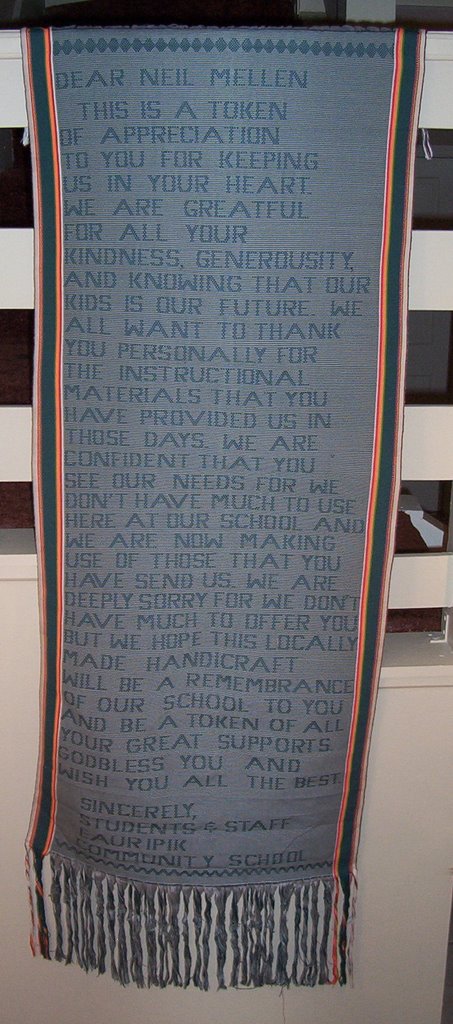
The Habele Outer Island Education Fund just received an elaborate hand woven lava lava from the students and staff of Eauripik Atoll’s Community School.

Habele is a non-profit organization promoting educational opportunity and accomplishment in the remote Outer Islands of Micronesia’s Yap State. The Habele volunteers and donors began regularly sending boxes of books, paper, pencils and other basic school supplies to the isolated Atoll of Eauripik in 2003.

This lava-lava, a woven skirt unique to the Outer Island, was addressed to the Habele President and reads “This is a token of appreciation to you for keeping us in your heart. We are grateful for all your kindness, generosity, and knowing that our kids is [sic] our future. We all want to thank you personally for the instructional materials that you have provided us in those days. We are confident that you see our needs for we don’t have much to use at our school and we are now making use of those that you have send us. We are deeply sorry for we don’t have much to offer you but we hope this locally made handicraft will be a remembrance of our school to you, and be a token of all your great supports. God bless you and wish you all the best. Sincerely, Students & Staff, Eauripik Community School

Eauripik is a tiny atoll in the Caroline Islands, hundreds of miles from the partially developed district centers of Yap Proper and Chuuk Lagoon. The inhabitants are primarily subsistence fisherman and gardeners. There is neither electricity nor plumbing and no cash economy.

For information about how you can help out the students on Eauripik, as well as those throughout the Outer Islands, visit www.habele.org.

11.23.2006

philanthropy, peace corps, commerce and culture


A few interesting links...

Market Magic: Nonprofits could access needed capital by turning donors into investors. Part of the series on Philanthropy at Slate.com

40 Years Of Peace Corps : A Long Partnership With FSM, Palau Celebrated. Commentary from Pacific Magazine.

Trade Is More Effective Than Aid. An editorial by Helen Hughes of the East-West Center.

Political Relationship Between Yap and the Outer Islands : Rank, Hierarchy and Routes of Migration: Chieftainship in the Central Caroline Islands of Micronesia. From a text published by the Australian National University.

For more information on the efforts of Habele, the Outer Island Education Fund, and its work promoting educational opportunities and accomplishment in the Outer Islands of Yap visit habele.org

11.16.2006

Aid to Micronesia: Government Grants or Personal Empowerment?

Donors Call For Reforms To Boost Micronesia Results
Pacific Magazine, November 10, 2006.

Some key points: Donors this week called for reforms to be stepped up in the Federated States of Micronesia (FSM) to assure greater progress in future assistance programs….Development partners noted that significant levels of assistance are received by FSM, but previous programs have not always achieved their objectives….They urged the government to demonstrate its commitment to achieving improved results through speedier reforms to [among other things]

-Promote more effective donor coordination
-Raise public awareness and understanding of reform priorities and development objectives.

ADB's strategy in the FSM focuses on three broad objectives: good governance, social service development, and pro-poor economic growth. Since joining ADB in 1990, FSM has received more than $97 million in assistance
.

Read the Article here.

Unlike the huge grants and infrastructure projects financed by foreign governments, Habele is focused on providing individual students with tuition assistance and basic educational materials in order to meet their academic (and ultimately personal and economic) goals.
This is truly capacity building in its purest sense. Visit www.habele.org for more information!

11.11.2006

First Quarter Grades Arrive

The Habele Outer Island Education Fund has received first quarter report cards for the two Yap Outer Island scholars attending Bethania High School in the Republic of Palau.

“Our scholarship awardees are doing well and they have much to be proud of” explained Tom Lutte, Treasurer of the Fund.

The transition is incredibly challenging but the girls are excelling,” noted Alex Sidles, Habele Secretary, in regard to the progression from attending the isolated community schools on the Atoll of Ulithi to the competitive academic atmosphere at Bethania.

Details of the girls’ school year accomplishments and an overview of the Habele public school library and support projects will be included in the forth-coming 2006 annual report. Habele is tax exempt non profit organization that provides scholarships, awards, and grants to students from the remote Outer Islands of Yap State in Micronesia. More details at www.habele.org.

11.09.2006

A Call for Pacific Cohesion

In an article highly critical of US policy towards the Pacific, Andre Vltchek argues that the island nations of Oceania should come together and develop a more centralized (or at least cohesive) regional voice. While the piece is inflammatory in tone (and limited in detail) it does raise some interesting points.

The big three, the U.S., Australia, and New Zealand, have divided the Pacific island territories. New Zealand now controls Polynesia, Australia is “in charge of” Melanesia (including the plundering of natural resources by its multinationals in Papua New Guinea), and the U.S. has a firm grip on Micronesia.

The New Pacific Wall: The U.S., Australia, and New Zealand Control the Pacific Islands is available at WorldPress.Org.

In laying out the grounds for greater unity Vltchek scathingly notes…

-Pacific Island votes at the UN are openly for sale…

-For several tiny nations, it became profitable to play the Taiwanese card...

-The economy of Palau, as for the entire Federated States of Micronesia (FSM), is largely dependent on the U.S. handouts…

…Inter-Pacific cultural and economic ties are being replaced by ties with the U.S., Australia, and New Zealand….

-Micronesian nations are securing cash through direct agreements with the United States by offering the military unlimited access to their territories..


He concludes:

[the] New Pacific Wall has fragmented this enormous area of the Pacific, once inhabited by diverse but historically intertwined cultures. There is an acute need for Pacific island nations to create a strong and united bloc able to negotiate with the rest of the world with one voice. Only such a bloc could effectively address economic, social, transportation, educational, and political problems confronting the entire region.

While Vltchek may be correct in his observation that developed nations benefit most from a patchwork of bilateral and unilateral polices with individual island states, his suggestion that the region as a whole is “historically intertwined” may be a slight exaggeration. Nor does he provide specific characteristics of a possible mechanism in his prescription.

That said, the article does raise important concerns and is well worth reading.

Rather than rallying for national or regional policy shifts, Habele remains committed to development in Micronesia’s remote outer islands at the level of individual students. For information on the fund's private school scholarships and public school library projects visit our website at www.habele.org.

11.02.2006

Film Clip of Outer Island Students


This is a short clip of children in a joint Kindergarten - First Grade class on the Island of Asor, Atoll of Ulithi, The students are copying sentences from a Dr. Suess book. The lighting is poor, as Asor does not have electricity. The children are lying on the concrete floor because it is cool (and the school has only a few chairs).

The library at Asor’s Community Elementary School (ACES) has been developed through the Habele Outer Island Education Fund's public school library project and the hard work of Peace Corps Volunteers. Check out www.habele.org for more info! Please consider donating to Habele in order to expand library development in the Outer Islands of Yap State, the most remote area of Micronesia.